


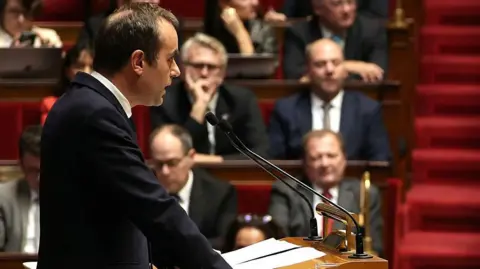
French Prime Minister Sébastien Lecornu has announced to the National Assembly that he backs halting controversial 2023 pension reforms, in the face of crucial censure votes later this week.
The modifications, which elevated the retirement age from 62 to 64, were regarded as key reforms in the French president's term.
"In the fall I will present to lawmakers that we halt the 2023 pension reform until the [2027] presidential election," Lecornu stated to applause from left-wing parties.
The Prime Minister was reinstated last week only 96 hours after he stepped down, and requires the approval of Socialist MPs in parliament if his government is to survive.
Political Pressure
Political rivals on the right-wing and far left have initiated censure votes on Lecornu's government, for Thursday morning and are calling for parliamentary elections.
The Socialists announced they would be ready to support the new government, but only if it commits to a total suspension of the president's retirement reforms.
"If he does not directly announce the words 'full and instant halt of the retirement changes', it will be censure," representative the socialist politician commented on television.
"He is holding his destiny in his own hands. He understands what he has to do if he seeks to prevent being the government leader who resigns every week."
Reform Background
The reforms were ultimately pushed through the assembly in last year, less than a year after the president was returned for a second presidential term.
There had been months of political debate, labor protests and street protests, and in the end the bill had to go through without a formal consent in parliament using a constitutional mechanism known as 49:3.
Recently, Lecornu said it was something many French people viewed as a "political scar" .
Budgetary Impact
On this week he made it plain to representatives that freezing the pension reform would cost 400 million euros in the medium term and a extra 1.8 billion euros in 2027. This will have to be "balanced with other reductions," the Prime Minister said.
The Prime Minister is France's third prime minister in the recent period but even if he remains in office he needs to get a spending bill through parliament that brings down a financial shortfall estimated to reach 5.4 percent of GDP this year.
The country's national debt earlier this year amounted to 3.4 trillion euros, or almost 114% of GDP, the third largest in the eurozone after Greece and the Italian nation.
Government Calculations
The Prime Minister has been one of the president's staunchest supporters, so his decision to change direction on such a contested measure demonstrates how determined the head of state is to avoid additional political crisis.
An economics expert, who was shared the prestigious award on this week, commented that he also backed a suspension of the retirement changes, because it would still come at a lower price than the government collapse that would come after another cabinet dissolution.
