

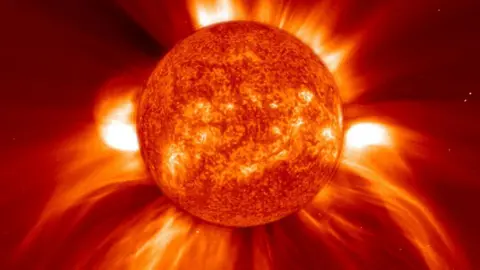
Regarding India's first solar observatory, 2026 is expected to be like no other.
It's the first time the observatory – that entered into space last year – will be able to observe the Sun during the peak of its solar cycle.
According to scientific data, this occurs approximately once every 11 years when the Sun's magnetic poles flip – the Earth equivalent could be the planet's poles changing places.
It's a time of great turbulence. It sees the Sun changing from peaceful to violent and is marked by a huge increase in the frequency of solar eruptions and coronal mass ejections (CMEs) – massive bubbles of plasma that erupt from the solar corona.
Made up of charged particles, a coronal mass ejection may have a mass up to a trillion kilograms and can attain a speed exceeding 2,000 miles each second. It can travel in any direction, including towards our planet. At top speed, the journey takes a CME 15 hours to traverse the vast distance between Earth and the Sun.
"During typical or low-activity times, our star emits two to three CMEs a day," says an astrophysics expert. "Next year, it's anticipated them to be over ten daily."
Researching coronal mass ejections is one of the key scientific objectives of India's maiden solar mission. Firstly, because the ejections offer a chance to learn about the star in the center of our solar system, and secondly, because activities occurring on the Sun threaten infrastructure on Earth and in orbit.

Impacts on Earth and Space Infrastructure
CMEs rarely pose immediate danger to people, yet they impact our planet by causing magnetic disturbances affecting the weather in Earth's vicinity, where nearly thousands of spacecraft, including Indian satellites, orbit.
"The most beautiful displays from solar eruptions are auroras, which are direct evidence that solar particles from our star journey toward our planet," the expert explains.
"But they can also make all the electronics aboard spacecraft fail, disable electrical networks and disrupt meteorological and telecom spacecraft."
Historical Solar Incidents
- The strongest solar storm in history was the Carrington Event that disabled communication systems worldwide
- In 1989, a part of Canadian electrical network was knocked out, leaving six million people without power for hours
- During late 2015, solar storms disrupted air traffic control, causing chaos in Sweden and some other European air hubs
- Recently in 2022, a CME had led to dozens of spacecraft failing
If we are able to see events in the solar atmosphere and detect a solar storm or solar eruption in real time, measure its heat at origin and track its path, it can work as advanced warning to switch off power grids and satellites redirecting them to safety.
The Mission's Unique Advantage
There are other solar missions observing the Sun, India's spacecraft holds an edge compared to rivals when it comes to watching the corona.
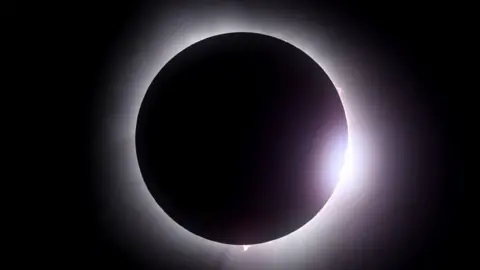
"The instrument is the exact size that lets it nearly mimic lunar coverage, completely blocking the solar disk and allowing it an uninterrupted view of almost all solar atmosphere 24 hours a day, throughout the year, even during solar events," says the researcher.
In other words, this instrument acts like an artificial Moon, blocking the Sun's bright surface allowing researchers continuously observe its faint outer corona – a feat the real Moon does only during specific moments.
Additionally, this is the only mission capable of examining eruptions using optical wavelengths, enabling it to determine eruption heat and thermal output – key clues that show how strong a CME would be when traveling toward Earth.
Readiness for Maximum Activity
In preparation for next year's peak solar activity period, researchers worked together to study the data obtained from one of the largest solar eruption recorded by the mission has observed recently.
This event began in September 2024 at 00:30 GMT. The eruption's weight was 270 million tonnes – for comparison that struck the ship was 1.5 million tonnes.
At origin, its temperature was 1.8 million degrees Celsius and the energy content was equivalent to millions of tons of TNT – in comparison the atomic bombs on Hiroshima and Nagasaki were much smaller in scale respectively.
Even though these figures make it sound massive, the expert classifies it as a "medium-sized" one.
The asteroid that eliminated the dinosaurs on Earth carried enormous energy and during solar peak occurs, there may be eruptions carrying power equal to greater levels.
"I consider the CME we analyzed happened when the Sun of typical solar activity. Now this sets the standard that we'll be using to evaluate what to expect during solar maximum occurs," he says.
"The insights gained will help us work out the countermeasures to implement to protect spacecraft in near space. They will also help achieving deeper knowledge of our space environment," he concludes.
